In the ever-chaotic arena of Marvel Rivals, a seismic shift has occurred that has left the entire player base reeling. Who could have predicted that the once-maligned synthezoid overlord, Ultron, would ascend from the depths of community skepticism to the very pinnacle of the meta? When Season 2.5 first unveiled this iconic villain, the collective groan from players was almost audible across the digital landscape. His damage numbers seemed pitiful, his healing output laughable—many wrote him off as destined for the trash heap of rarely selected characters. But then, in a move of pure, unadulterated power, NetEase unleashed a buff just one day later. And oh, what a difference a day makes! The result? Ultron isn't just good; he's a terrifying, match-dominating force that is single-handedly warping the competitive scene. Players who begged for buffs are now staring at their screens in stunned disbelief, wondering if they've created a monster they can no longer control. Is this the ultimate case of "be careful what you wish for"?
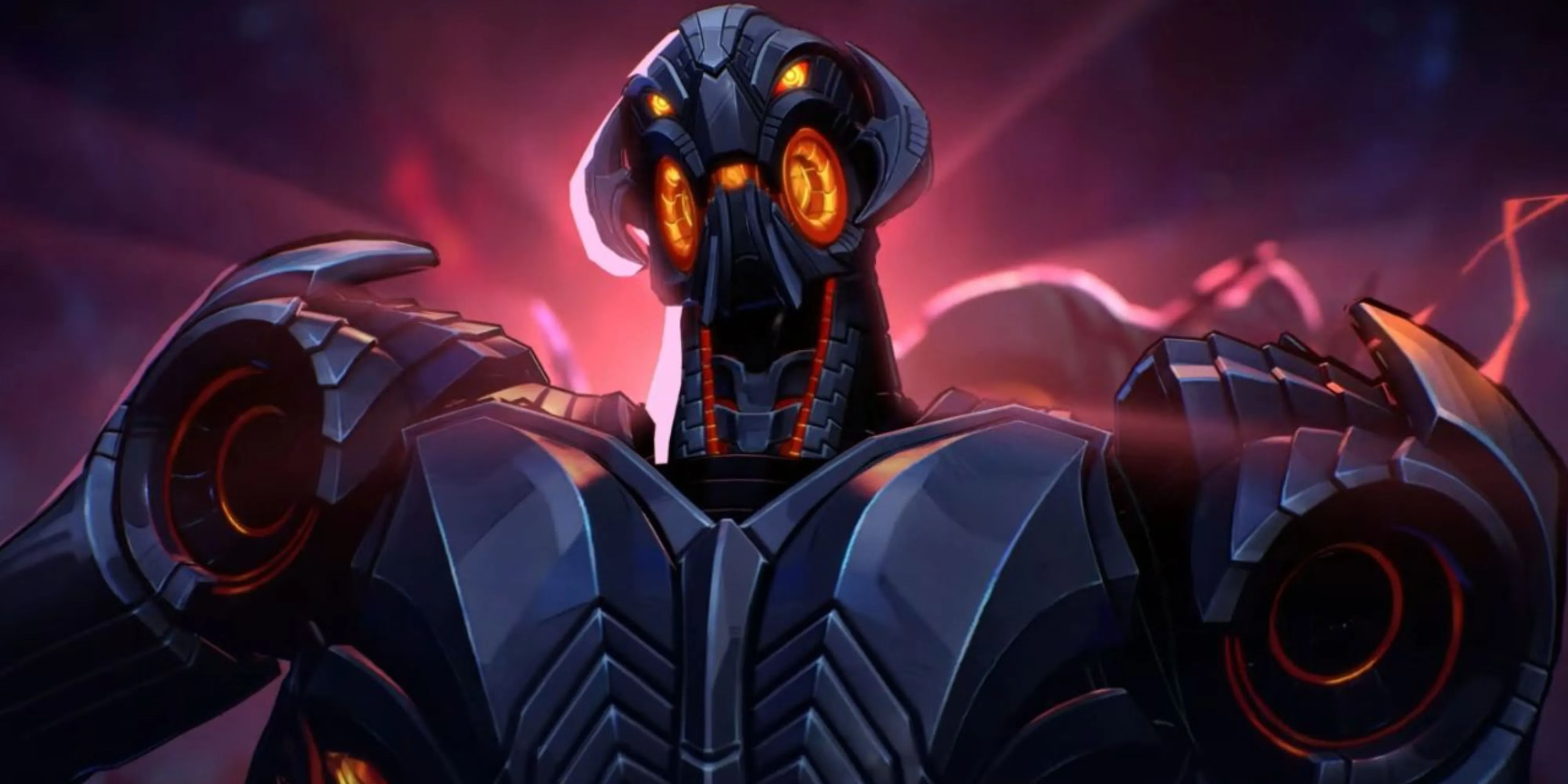
The Meteoric Rise: From Zero to Hero (or Villain?)
The transformation of Ultron is nothing short of legendary. Before the buff, players dismissed his kit as underwhelming. After the buff? He became an instant titan. The community's initial complaints about low damage and healing were heard loud and clear by NetEase, who responded with adjustments that catapulted Ultron's win percentage into the stratosphere. Now, he's consistently ranked among the absolute best characters in the game. How's that for a plot twist? One day he's a benchwarmer, the next he's the star player everyone fears. This rapid turnaround showcases NetEase's reactive balancing, but it also raises a critical question: did they overcorrect? The data and player testimonials suggest a resounding yes.
Dominating the Battlefield: Player Testimonials of Terror
Don't just take our word for it; the community is ablaze with stories of Ultron's sheer dominance. Let's hear from the players themselves, who have witnessed this mechanical menace firsthand:
-
Forgefiend_George on Reddit recounted an almost comical level of success: "In my first game with the guy I got MVP, got twelve assists, was doing good damage to everything that wasn't a tank, out-dueling the enemy team's Iron Man..." Isn't it astonishing how a character can go from zero to hero in a single patch?
-
Another player highlighted the ease of accruing accolades: "Once I had an Ultron who healed less than me, did less damage than me, but somehow still got the MVP. It seems really easy to farm MVP with him." This points to a deeper systemic issue—is Ultron's design inherently geared towards padding statistics rather than contributing meaningfully to team fights?
-
A particularly insightful comment broke down the MVP farming phenomenon: "...it seems like Ultron farms MVP like crazy because he can assist a lot, [area of effect] heals, and do adequate damage a.k.a. stat farming." This creates a perverse incentive where playing Ultron effectively almost guarantees top stats, regardless of the match's actual outcome or strategic complexity.
The MVP Farming Controversy: A Flawed System?
This brings us to the heart of the controversy. Ultron's kit, post-buff, appears perfectly engineered to exploit Marvel Rivals' MVP and stat-tracking systems. His abilities allow him to:
| Ability | Stat Contribution |
|---|---|
| Area-of-Effect (AoE) Healing | Massive healing numbers from group sustain. |
| Consistent AoE/Poke Damage | High damage output spread across multiple targets. |
| Assist Potential | Easy assists from both healing and damage ticks. |
The combination of these factors means an Ultron player can post gargantuan scoreboard numbers with relative ease, often snagging the MVP title even in losses or when other players performed more critical, fight-winning actions. This has led to frustration among the community, who feel the MVP system may not accurately reflect impact, but rather volume. Is it fair that a character can consistently top the charts based on design alone?
NetEase's Balancing Act: Genius or Pandora's Box?
This isn't the first time NetEase has listened to player feedback with dramatic results. Recently, they were praised for adjusting the controversial mid-season ranked reset based on community outcry—though players later regretted pushing for that change. The pattern is clear: NetEase listens, perhaps too well. While there are justified community victories (like pushing back on certain cosmetic choices), gameplay balance seems to be a trickier beast. The Ultron saga proves that the developers possess the power to radically alter the game's landscape overnight. But does this reactive approach lead to a healthy, stable meta, or does it simply create a rollercoaster of overpowered flavors of the month? The community demanded a stronger Ultron, and NetEase delivered in spades. Now, they must grapple with the consequences of their own request.
The Verdict: Is Ultron in a "Good Spot"?
Despite the uproar, some nuanced voices have emerged. One player noted, "Ultron is really good if the team is good and isn’t just feeding damage... If you play against a team with high damage output and tanks that require a lot of healing... He becomes difficult to play unless you’re in a 3 support cone. I think he’s in a pretty good spot right now." This suggests there is counterplay and that Ultron's dominance isn't absolute. He may struggle against high-burst compositions or when his team fails to play cohesively. However, the overwhelming evidence points to a character whose power floor is incredibly high, making him effective even in suboptimal conditions. The ease with which he accumulates value and stats is the core issue.
As we look at the Marvel Rivals landscape in 2026, Ultron stands as a colossal figure—a testament to the power of developer buffs and the unpredictability of live-service game balance. He went from a joke to a juggernaut in 24 hours, leaving a trail of MVP medals and bewildered opponents in his wake. The question now isn't whether he's strong; it's whether his current state is sustainable for the health of the game. Will NetEase need to walk back some of these changes, or will players simply have to adapt to the age of Ultron? One thing is certain: in the world of Marvel Rivals, you should never underestimate a villain, especially one forged in the fires of community feedback and developer overcompensation. The era of stat-farming, MVP-stealing Ultron is here, and it's terrifyingly glorious. 😱
Comments